Tuesday, 22 September 2009

Blood spilt at Sky pilot battle scene

Another session of perfect conditions at Sky Pilot today and the moves have been done on the big highball. Still thinking it’ll be a V14 with 10 moves of about V10 to the crux and then the big move. This progress seems like a fine excuse to abuse the training board extra hard over the the coming weeks and really go in for a good battle on this project. I definitely don't have my bouldering 'snap' back just yet after the summer of getting fit at hanging about on multipitch staminafests and walking back and forth across moors on Orkney.


I finished the session dripping with blood from the hand after slicing my little finger open good style on a blade of grass. Yes you read that right. Thats what I get for throwing caution to the wind and pulling out a few clumps of greenery from the sit start footholds without a stout pair of gloves on. In recent weeks, climbing has seemed just about the safest part of going climbing.

Monday, 21 September 2009

Some lectures coming up


I’m talking at various places soon if you’d like to listen to some perspectives on climbing, trying hard, choosing your battles, if succeeding on projects is really important or always worth the sacrifices and other things such as negotiating with local wildlife make progress on E11s.


First up I’m talking on Sunday night of the Edinburgh Mountain Film Festival on Oct 18th. Tickets are on sale now and more details about the festival lineup are on the EMFF site.


Soon after I’m in Dundee helping Tiso celebrate 20 years in Dundee. Full details of this on the Tiso site here.


I’ll show you some nice pieces of video of some of my best climbing efforts recently and hopefully make you see aspects of your climbing in slightly different light, as I have in the past 12 months.


Whatever you do, go left of the fulmar. Pic: Michael Tweedley

The timing is everything

Blair hits the Roaring Forties (E3 5c) on Mucklehouse Wall. The route would also have described the weather conditions at the time despite the sunshine


A nice evening at Rackwick Bothy as we arrived… too late.


Blair struggles to get his gear out of his rucksack without it blowing to Norway at the top of Mucklehouse Wall. The top of the old man of Hoy and most of St John’s Head behind in the cloud.


"Just realising how much of a problem I have staying relaxed a lot of the time. I'm sat here in a beautiful evening in Rackwick with nothing to do except enjoy the moment, but all I can do I worry that tomorrows forecast is bad and how poor our chances are of getting a shot at the longhope route, never mind getting to the top.


People often tell me they think I must be patient after hearing about the extended trials of hard project climbing. But the truth is I'm actually just good at staying impatient for very sustained periods. At times, acute impatience for success or progress is utterly vital to break out of sticking points. It can be the greatest gift. But the timing of it is everything. My major failing has been to stay locked in battle psyche mode when the battle can't be fought today. Missing opportunities to relax, regroup and focus

on nights like tonight is just as bad as getting to the crux move and giving in at the discomfort of the hard effort..."


...I wrote the above words on my phone on while watching that nice sunset after arriving on Hoy with Blair and Cubby. As you can see I’d done a reasonable job of feeling positive despite the forecast telling us everywhere in the UK would be enjoying the September High pressure except us with a windy, drizzly cold front on it’s periphery. Perhaps we could have awoken to decent conditions and a successful day. But as it turned out we woke at 4am to the sound of thundering waves and drizzle.


We managed to squeeze out a couple of routes on Rora Head over two days between the rain. But not without much

chattering of teeth in the cold gale.


As soon as got back onto the Scottish mainland and back underneath the high pressure, we drove past flat calm shores and through warm sunny hills to get back to Lochaber for work. It felt just a bit cruel I must say.


Quick the sun’s out, get a route in! Blair descends Rora head while a grey seal watches from the drink below


So much as I hate to say it, thats probably the lasthope for longhope this year. Sure I could go back armed with more gear to keep us warm and dry on the wall for a forced bigwall style autumn ascent. But my goal from the start has been to climb this route in a single day push. And with the 18th pitch being E10 it’s not going to happen unless we are moving super fast and light.


But sudden freedom to make other moves on rock has been only a temporary downer. Sessions on the two big bouldering projects in Glen Nevis have underlined my wee strength increases from the new training facility. I managed two whole foot moves more than before on the Font 8c project thats featured in the committed II film. I’m even more excited about the bigfoot project which narrowly escaped all it’s individual moves being completed yesterday. I forgot how gratifyingly convenient bouldering is compared to bigwall trad dirty, birdy, turfy, soft, loose E11 sea cliffs in the windiest place on the goddam planet.


A mention goes to Kev for a one handed and helmetless ascent of Firestone E7 the other day. Nutter.

Monday, 7 September 2009

A MacLeod near miss

The west highlands almost lost two of it’s MacLeod’s to the A86 on Saturday morning after Claire wrapped her nice Audi around a tree. I was sitting in the passenger seat and believe it or not I was happy it was a direct head on hit on the tree, because if not it would have been over a retaining wall with a probably terminal drop on the other side.


A very wet road, a little too much speed for the bend, and a little touch of the brakes on the cusp of the bend were the combination of causes. The back of the car slid, followed by wild veering and steering, and the next thing we saw in the windscreen was a large tree.


We had a split second to either tense or relax in preparation for the big smash.


It felt a little surreal stepping out of a completely re-shaped car, with only a sore neck and the odd scuff between us. The split second after the impact of turning to Claire to see if she was still with me was not something I’ll forget in a hurry. Thankfully she was looking back at me and immediately agreeable to getting out of the car.


Apologies to my climbing masterclass students who had a bit of a wait for me to arrive and a slightly frazzled coach once I finally did.


Kudos to Mr Gardner for being on the money that there are often more pressing things worth worrying about than falling off rock climbs, terrorists and nasty flu viruses.

Thursday, 3 September 2009

Rollercoaster time again

Michael enjoying the St John’s head experience


It’s been another journey of big ups and downs on Orkney over the past few days with Micheal. But every time I have a fantastic trip, regardless of results. Duly, the wind prevented us from even getting to the edge of the cliff when we arrived, but spending the day soaking up the atlantic ferocity provided much amazement at the forces of nature on display on this island.


St john’s looking nearly as big and mean as it actually is.


So with conditions near the top of the wall too extreme, we tried playing on the bottom, and between the rain, we sussed out some of the lower pitches. We had a good day climbing about halfway up the wall, but fairly cumbersomely, equipped with big wet boots to get through pitches of soaking off-vertical grass pitches and wearing our Gore-Tex’s to keep out the rain and fulmar hurl.


This was the ferry on the way there! (must’ve been the training…)


I felt pretty down about the whole thing one morning. On the one day we could go on the crux pitch from the top, the dampness in the sandstone meant I pulled three small but important holds off the crux pitch. It was all seeming a bit too tenuous a goal to climb such a hard pitch here, with conditions against us and soft, rock, angry wildlife and without the previous 17 pitches using up precious energy for the big pitch. At these times, realising it’s not going to ‘go’ this trip, or even next trip, it’s hard not to let frustration reach the surface. Frustration with myself that is. On one hand I understand that I am not here for an easy route. In fact, if it just happened and was an E10 I’d probably be even a little disappointed it wasn’t harder. But on the other, I’m here to climb and to chase after that feeling of a hard climb feeling effortless. But all I seem to be doing is walking back and forth across that heather bog day after day in the rain and gale. I found myself if the messed up position of being on a climbing trip to an amazing place, but dreaming of my three metre high board at home. Thankfully such madness was only temporary.


Michael descending the jurassic park slopes to the base of the cliff. I decided to use a highly dynamic technique for the last 30 feet of this, shredding my Gore-Tex nicely.


Just to have been to the outstandingly beautiful place that lies remote from the reach of most people at the base of St John’s Head made this trip worth it.


The fulmar chicks are just getting to flying school age now, and we witnessed several amusing ‘baptism of fire’ first flights and semi-falling descents of St John’s Head from young flyers. Not all of them learned quickly enough as the above demonstrates.
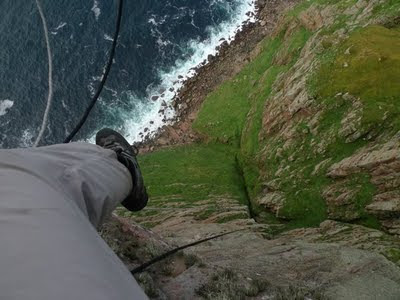

1200 feet of air beneath the feet. Doesn’t seem real.


The best part about trying something completely different like this climb is realising how completely rubbish you are at the weak areas of your game. I always get climbing logistics quite spectacularly wrong. This trip was not different, with some impressive errors that seem so silly in hindsight, and a few I’ll forgive myself for needing to learn the hard way. But they are learned, and I have knowledge for next time, whenever that will be?

In praise of friction

My recent travails on the massive lump of sandstone that makes the towering St John's Head brought home an important truth about climbing for me; so many varied things are involved in the enjoyment of rock climbing, and of these, friction is an extremely important one. I spend a lot of time in my work related to climbing trying to explain in detail climbing's attractions. Yet it still seems impressively resistant to being encapsulated by any single idea or perspective. That in itself might be an appealing idea (for another day). The breadth of dimensions in which climbers find satisfaction through their activity keeps surprising me to this day. But perhaps inevitably only a few are commonly talked about.


Very fashionable again right now is the visual dimension of the 'king line'. If the climb looks amazing then it's worthwhile. The length of the climb has always been another popular measure of quality or stature in climbs, even despite bouldering and sport climbing becoming so big in the last couple of decades. But the actual interaction with the rock climbed is only often referred to in the context of the texture and shapes of different rock types and their merits. Through the medium of the activity of rock climbing, the various rocks on show around the planet can really be appreciated as quite amazing and beautiful stuff. But perhaps still in a way thats hard to put into words, a problem I'm sure geologists must surely share. Andy Kirkpatrick often laments in his lectures that even talking about the actual climbing activity is boring. True, it might not be a bountiful source of entertainment for telling climbing stories. But if the raw feeling of climbing rock brings on a magic sparked feeling of pure satisfaction even if only for elusive moments, then it's worth a more involved look. Understanding it fully might be too lofty a goal even for a whole lifetime of climbing rocks.


It was while climbing some god-awful, chossy vertical sand with the consistency of sugared pastry on Longhope that a previously subconscious appreciation of rock friction suddenly became stronger than ever. The feeling of improbable weightlessness caused when just the correct atmospheric conditions combine on pristine rock for an ethereal moment is something desperately hard to relate, but instantly recognisable to those who’ve tried climbs near enough their own limit to experience it. Two moments stand out - one was the weirdness of the ‘sticky-damp’ at Stoney Middleton on a misty, dank and humid day. Without any warning (i.e. Climbing like a potato just hours before) I flashed an apparently wet V10 without any effort, but half an hour later the weather changed and I couldn’t touch it despite it actually drying up! Another was on Rhapsody after a raging September squall had soaked and cooled the rock and rapid-dried it in a 60mph wind. I still fell off, but quite possibly I think I lost my concentration because I was trying to understand how all the holds suddenly felt so much better! Both experiences lasted only moments and neither were particularly memorable in other ways, but they obviously remained strong in the memory for a reason.


So the other day on Longhope I was cursing the complete absence of any frictional properties of this section of diabolical rock. So how then does it follow that I still enjoyed the climbing here? My second realisation in this moment was that only because the friction was so frighteningly absent, that the subtle balance required to move between the holds was so much sweeter to experience.


The message of this post? Whatever rock you always climb, think of the exact opposite, and go and climb some of that for a bit. The very aspects you might hate about it might well reveal something even stronger to enjoy.

Wednesday, 26 August 2009

Another atlantic depression sets in

Gutted. My gear is laid out neatly ready on my loft floor for a trip to my project. Today at work at the Ice Factor I went on one of my old hard problems from last winter’s training that I’d only done a couple of times after many tries and walked up it first try. Fit, strong and psyched. But once again the atlantic weather has the last word.


We are still hoping to make the journey and sit out the storms and grab any chances we get to hit St John’s. It’s easy to smugly pronounce that fortune favours the bold (or defiant) on the occasions that it does. But sometimes, or course, you’ll sit on Orkney for a week in the rain and come home thinking differently.


So we’ll see which it is.

Monday, 24 August 2009

Project progress reaches sub-cellular level


Get in: Lactate dehydrogenase


It’s Scotland, it’s late summer, and so it’s raining. Well, it’s raining on all my days off anyway. So the only progress towards my project is currently going on deep in inside my forearms which are hopefully amassing a formidable armoury of anaerobic enzymes as I write.


This week I have either just trained, training thenoo, or should have started training again already (the latter is the current situation, rectified as soon as I stop writing this post). My new board is not looking so new. And I’m satisfied with that.


Less pleasing is that all this training has woken up my complaining elbow, which had been feeling tough and strong and well on the way to being declared 100% healthy. It wouldn’t be real life if it disappeared so easily. So I have to pull back a little on the hangboarding and just stick to those nasty circuits of lactic pain.


I love them really.

Sunday, 23 August 2009

Safer, safe and ‘less dangerous’

Claire after her skydive yesterday. Not looking too scared


I was just listening to Amartya Sen explaining on radio about his ideas about justice in the world, and his way of looking at this aspect of humanity struck me as just as relevant in another.


His thesis in the world of justice is that we should think in a more pragmatic, and less idealist way in order to achieve the best possible outcome for people. Specifically he has the idea that we pour a huge amount of energy trying to solve completely particular injustices, with the intended outcome being to make them 100% ‘just’. But, he says, the ideal of a perfectly just scenario often remains out of reach. Instead, if we first seek out the biggest and deepest injustices, and measure success against their starting points, rather than against the ideal finishing point of perfect justice, we will end up increasing overall justice by a larger amount. So the focus on scrubbing out the last remains of stubborn injustice becomes not just a black hole for our resources, but a distraction from deeper injustice elsewhere.


It struck me that this parallels closely recent arguments about risk in life and society. Economics right now is teaching popular society a lot about the importance of risk. Namely that pursuing the ideal of eliminating risk is actually harmful to economies, just as very risky and unstable situations are. Similarly, a statistical perspective minus the blinkers of a ratings driven media such as this book on the risks we face highlights some of the ridiculous situations we find ourselves in when we attempt to eliminate tiny risks (such as terrorism) and allow these to completely distract us from huge risks elsewhere.


Amartya’s idea projected onto risk makes a lot of sense to me and to me reflects closely the decision making process I’ve aspired to in the risky climbing I do. Other climbing bloggers thoughts recently (such as Dougald and Will’s) have reminded us well that believing in complete safety in climbing will always prove a fallacy. So it’s important to try not to be distracted by making tiny risks tinier, if larger ones lie ignored in the background (and they often do in my opinion).


A common example that often worries me when listening to other climbers discourse on safety is a fascination with the fine details of climbing equipment systems. Nothing wrong with that whatsoever, so long as it’s seen in context of the whole picture of climbing safety, which is often isn’t. The trouble is that our safety systems relating to climbing equipment are only one link in a chain of factors that determine how much risk we face when climbing.


The ‘soft’ skills (I hate the term but can’t immediately think of a replacement) of our tactics, decision making and movement skill on rock, ice or mountains are the other, larger part, and they often suffer relative ignorance.


A more specific example; Out of the climbers I know who onsight E6 or harder, I can't think of any who aren’t expert at downclimbing (out of trouble). Why? Quite simply, having this skill allows you to go with far less danger where it would be hideously dangerous to rely solely on ‘up’ climbing ability and safety equipment. In contrast, the trad climber’s I know who’ve suffered a series of confidence destroying serious falls are more often than not poor at climbing down out of scary situations. I’ve had a million climbers ask me all sorts of weird and wonderful questions about the fine points of equipment, and strategies for it’s use, and it often shocks them when I don’t always know an answer. But I can’t recall ever being asked about downclimbing.


Important things are often at the mercy of things less important. Looking for dangerous things to make less dangerous will often be more successful than looking for anything to make perfectly safe.

Friday, 14 August 2009

Another link in the chain

St John’s Head, looking angry


I made the journey back to Hoy, over Cuilags and across the plateau once again and uncoiled my ropes in mist and the ever present buffeting gale at the edge of the cliff. I threw a coil of rope into the mist, but it blew right back over at me. I watched the fulmars for a bit while I got ready to to a ‘bag rap’ to get over the edge in the wind. They were giving me the eye as they swooped past, wings pulled in tight in the mega updraught. No doubt wondering why I’d chosen to be here in this grimness.


Claire enjoys a break from the westerly gale in the shelter of Cuilags


But the arrival of rain on the raging wind soaked everything within seconds and there was nothing for it but to jog back over the plateau like a drowned rat and eat vast mountains of pasta and vanilla cheesecake at the hostel with Claire.


It’s grim, lets go home and eat cheesecake!


Next day, the soaking started even earlier before we’d even reached the crag and with an armageddon front forecast for the following day, it was looking like a wet hillwalking trip to Orkney. We sat on the edge of the cliff, waited, filmed rain. And so the sun came out for us, and the climbing could start.


Not a happy chap. A fulmar vomits in my general direction


It started for me with a dousing of regurgitated fish and bile from an angry fulmar on the abseil descent. It made for a heady smelling 6 hours on the rope I can tell you. Didn’t seem to do my climbing too much harm though. I got my objective of the big link through the entire top pitch on the shunt.


So what happens now? Well, I have to wait for a bit until I get a chance to return to see if I can climb through all those 18 lower pitches and even get to the big pitch, never mind the top.


When the passenger ferry takes a detour around Hoy to avoid the gales across St John’s, perhaps the climber should follow suit? Or not.


I can’t say I’m too confident it’ll go. But I’m confident It’ll be quite an experience trying. In many ways it still feels like early days for trying this project, and it’s probably good for me to view it that way anyway. I’m on the rollercoaster of hard new routes; One minute it feels like E10 and possible soon, the next it seems way out of my grasp. It's really too big to get a handle on yet.


I guess right now I have to focus on what’s under my control. And thats training, training, training.