Wednesday, 6 March 2013
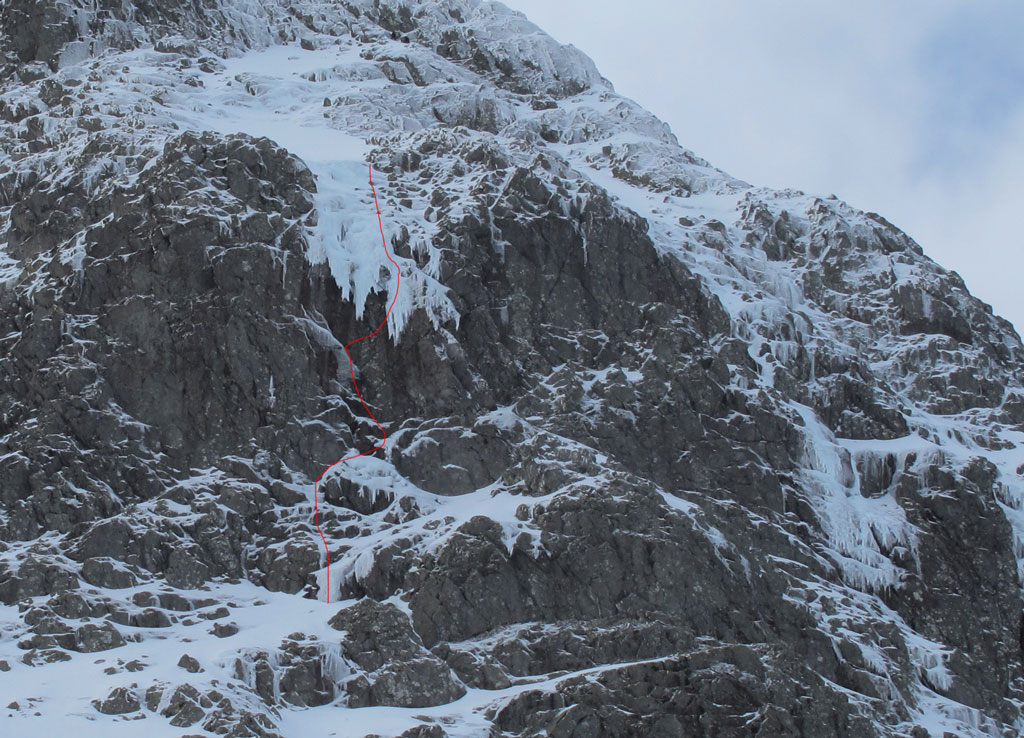
Helen, Harry and I headed back up Observatory Gully to find something nice to climb, with no particular plan. We kept going higher and higher in the hope of finding something mixed in good condition, until we found ourselves standing underneath Gardyloo Buttress. Funnily enough, there was a roof up that way I wanted to look at, but it had no ice on until the lip. So we opted for something more slabby and had a chilled ascent of Left Edge Route (VI,5). The ice was a bit unreliable, and protection pretty bad, so it was a good idea to keep the weight on the feet. Thankfully, once over the steepness there was solid ice and a cruise to the top. On the way down there was talk of rock climbing..
Gorge boulder video
As promised, here is a wee video to show you the problems I did on the Gorge Boulder in Glen Nevis the other day. These were just filmed by myself with the camera on tripod, but hopefully they serve to show you what’s on offer up the glen that’s off the beaten track from the established boulders.
To get to the boulder, park at the Steall car park at the road end. Walk up the Steall path for a few hundred metres to where it starts to steepen a bit. If you look directly across the river, you’ll see the boulder in the trees at the same level on the other side. The river is best crossed quite high up, not far below where it bends round into the gorge where it widens with plenty of boulders to hop. If the river is really high after rain, you might have to walk from Paddy's Bridge (the wooden bridge a km short of the car park). Approach takes 10-15 mins. Get there before the midges do.
There’s more to be done on the boulder. Feel free to bring a rope and wire brush and put in a few hours. Oh, and take the grades as very rough guides - I've been out of the loop of repeating boulder for a long time so I have no clue if they are even close. BTW after being closed for ages, Cafe Beag in the glen is open every day this year from 8-6. Pretty good place for fuelling up or waiting for rain to stop etc.
Posted by Dave MacLeod 5 comments
Labels: Glen Nevis, Scottish bouldering
Monday, 4 March 2013
Perfect bouldering day
Mega new boulder in Glen Nevis which I’ve given a good clean and opened 6 new problems in the easy to mid grades so far. ten minutes walk from the road, yet in complete solitude. I filmed some of them too and will make a wee video and topo shortly. Now the easy ones are done, time to work on the harder ones. This really was a perfect climbing day, great temperatures, great sights and sounds of nature all around, and great climbing. Bouldering above uneven landings was still feeling more like soloing for me right now though. But I am getting slightly more confident.
Posted by Dave MacLeod 2 comments
Labels: Glen Nevis, Scottish bouldering
More great weather and new routes
Nice new route on Ben Nevis, climbed with Helen last week. Once again I was feeling a bit jaded after cleaning new boulder problems the day before, so it was nice to give the legs a workout instead. My ankle seemed to handle the strenuous bridging ok. However, there were some positions it just didn’t like, so I ended up using the old knees a fair bit!
Posted by Dave MacLeod 0 comments
Labels: dry tooling, winter climbing
Winter, dry, both or none?
Obviously, the dry tooling route I did on the CIC cascades under the Ben Nevis north face last week was going to provoke a bit of debate. In my mind it’s perfectly suited to climbing in this style and it’s no threat to the traditional Scottish winter routes because it’s so clearly different from them. It did make me wince when I saw UKclimbing.com include a Scottish winter grade in their headline reporting the route. I didn’t give it a Scottish grade for a good reason! I should have seen that coming I guess, although it was hard to foresee that a casual comment by me comparing it to a similar piece of climbing terrain with a winter grade would mean folk would then take this one as a winter route. A bit like saying an E8 trad route has 7c+ climbing - it’s still different from a bolted 7c+! This seemed to fuel a bit of debate about how it related to the traditional winter climbing game. To me, it’s totally clear the route is a tooling route, not a Scottish winter route. Clear and simple.
Winter condition or not? What do you think?
A further interesting twist came when the other new route I wrote about (The Snotter) was questioned for not being in winter condition. I must say that took me seriously by surprise. I’ve done plenty of mixed routes that were on the borderline, but it didn’t enter my head that this one wasn’t in good condition. Simon Richardson wrote a particularly below the belt post on his blog which is here. For some reason he didn’t mention my name in it, and is was a little weird that he wrote such strong words and then reported another new route of mine in the very next post. Anyway, the reason it took me so by surprise was the focus on the section of overhanging wall to get between the ice grooves below and the hanging icicle above. I deliberately went on the route because the recent sunny conditions has been good for helping the grooves below the icicles to become iced. In the 55 metre crux pitch, around 47 metres was climbed on water ice, with 6 metres crossing a grossly overhanging wall underneath the roof to get to the icicle. The 30 metres of grooves below the roof were climbed on ice, initially stepped iced slabby ledges, then a thin ice smeared rib and groove, apart from a few hooks on the right of the ice. Once on the icicle, there was a long section (15 metres at least) before the angle even started to lie back.The downside of this mix of conditions was that the overhanging wall itself was pretty dry. My thinking was that this is par for the course for this type of route. The sun helps more ice form, but at the expense of the rime. My interpretation (which may be ‘wrong’ if such a judgement can truly be made) of Scottish winter conditions is that basically the route must be wintery in appearance. If it was nearly all dry mixed with a little ice, it would be outside that definition and I would have come back another time. But the reality was the pitch was nearly all ice with a short section of dry rock.
Some folk argued that maybe it should be left alone in case it dilutes the Scottish winter conditions ethic. I personally don’t agree with this. My feeling is that a one size fits all ethic for anything climbed is unnecessarily simplistic. It’s a shame not to climb that crack just because it doesn’t get rimed up. It’s an excellent climb.
More so than any other climbing discipline, Scottish winter climbing seems to be awful scared of losing what we have. Of course it’s special and worth defending. Perhaps because I like going for the steepest routes I’ve spent more than my fair share of days walking in and turning on my heel because the project is not white enough. It’s natural to resist any changes (even if they are only additions) to the status quo, but not always good. Balanced against the fear of losing what we have must be a fear of losing what we could have. To me, the diversity of British climbing has always been it’s greatest asset. A strict and narrow focus on what can be climbed with tools is a strength in upholding a strong ethic, but a weakness in undermining the diversity of climbs that can be done. I just don’t see that the threat to the Scottish conditions ethic is real. Rather than diminished over the years I have been a climber, I feel it has strengthened. The ethic is so strong, it has room to accept some ‘outliers’. However, that is of course just an opinion of one and may be outweighed by those of others, which is no problem. If other folk thought the tooling route was a good idea, very few have come out and said so.
A further interesting twist came when the other new route I wrote about (The Snotter) was questioned for not being in winter condition. I must say that took me seriously by surprise. I’ve done plenty of mixed routes that were on the borderline, but it didn’t enter my head that this one wasn’t in good condition. Simon Richardson wrote a particularly below the belt post on his blog which is here. For some reason he didn’t mention my name in it, and is was a little weird that he wrote such strong words and then reported another new route of mine in the very next post. Anyway, the reason it took me so by surprise was the focus on the section of overhanging wall to get between the ice grooves below and the hanging icicle above. I deliberately went on the route because the recent sunny conditions has been good for helping the grooves below the icicles to become iced. In the 55 metre crux pitch, around 47 metres was climbed on water ice, with 6 metres crossing a grossly overhanging wall underneath the roof to get to the icicle. The 30 metres of grooves below the roof were climbed on ice, initially stepped iced slabby ledges, then a thin ice smeared rib and groove, apart from a few hooks on the right of the ice. Once on the icicle, there was a long section (15 metres at least) before the angle even started to lie back.The downside of this mix of conditions was that the overhanging wall itself was pretty dry. My thinking was that this is par for the course for this type of route. The sun helps more ice form, but at the expense of the rime. My interpretation (which may be ‘wrong’ if such a judgement can truly be made) of Scottish winter conditions is that basically the route must be wintery in appearance. If it was nearly all dry mixed with a little ice, it would be outside that definition and I would have come back another time. But the reality was the pitch was nearly all ice with a short section of dry rock.
A central view in my own new route climbing has always been that I don’t want it to be at the expense of anyone else, even if I don’t agree with their position or motives. Clearly, some folk feel that way. So I have taken away my blog post about the routes and recommend that folk forget about them, if that is what they want to do. They still exist of course, in my memory as great days out and two of the most fun climbs I’ve done in a while. Nothing more ultimately matters. Anyone else is welcome to climb them as first ascents if they feel those ascents are more worthy.
Posted by Dave MacLeod 3 comments
Labels: dry tooling, winter climbing
Tuesday, 26 February 2013
Recent adventures on rock
During the past three weeks, life has been progressively more manic, as is normal in Lochaber at this time of year. Usually in February, the weather gets amazing for almost all types of climbing, and this season has been especially good. Trying to get anything else done apart from new routes is quite a challenge and usually involves late nights and early starts. Maybe the rain will return by March and I’ll take a rest day?!
When I got home from Spain, I was pretty keen to get into the hills. I started off with a day on the Ben with Kev and could hardly walk the next morning. However, my ankle seemed to continue to adapt and I went back up a couple more times. Since both of us were only really able to walk short distances with big packs, we opted for the CIC hut cascades. Kev cruised the icefall.
Next up I went to a ridiculous boulder roof in the glen. It’s quite low to the ground and fully horizontal. An acquired taste maybe - a bit like a darker version of the darkness cave in Magic Wood. There’s 25 feet of horizontal climbing on brutal crimps in there, with three logical starts. The shortest link will be Font 8aish and the full trip looks like solid Font 8b+. I couldn’t imagine doing it at the moment, but I did do about half the moves on my first session.
I’ve also been trying a bit of running with mixed results. I did some trail and hill runs up to 12 miles and was getting on fine. Then one evening I did some short fast sections since it was already getting dark after the climbing. I misjudged the angle of a boulder on the trail and hit the ‘no go zone’ in my ankle hard and let out a yelp. It’s been worse ever since, which is rather depressing. I can’t really do much except hope I’ve not done more damage. Not good.


Ardverikie deer forest. Here be boulders...
The next day I was getting pain even walking which put a downer on an otherwise great day out in Ardverikie Forest returning to a boulder I’d found on a run two years ago. I went to look at a roof that I’d estimated about Font 8b. But to actually try, it felt way harder. I pretty much gave up, although to be fair I wasn't in the most positive frame of mind, and the easterly was biting cold. It was a series of savage first joint undercuts in a roof with microscopic granite crystals level with your head for feet. A bit like doing harder versions of the Hubble undercuts crux about 5 times in a row. Maybe I’ll make a model on my board and try it once more in the spring.
The solid river Nevis today, near Steall.
Dan cleaning new problems, new boulder in Glen Nevis today.
Today saw some great new problems get done after a monster cleaning. I'll take some pictures of them next time. I did the problems almost in the dark since we were brushing for a lot of the afternoon. The boulder has probably 15 problems to do from Font 5 to 8A+ on the usual lovely honeycomb Glen Nevis schist. I hope my arms aren't too tired for tomorrows session back on the Ben. Off to sleep!
Posted by Dave MacLeod 4 comments
Labels: Ben Nevis, dry tooling, Glen Nevis, winter climbing
Monday, 28 January 2013
Stepping it up a bit now
Climbing 'Malsonando', Gandia.
During the week in Spain I have been doing some 7b and 7cs onsight just to get into the flow of climbing again, but I was also keen to see just how far away from recovering my form on harder routes. So I tried an 8c called Malsonando at Gandia.
I had no idea how I’d get on. Before coming out, since starting climbing again I’ve had 6 weeks or so of some indoor climbing and started from a very low base of fitness and very gentle climbing on easy ground at first. I did manage to climb the 8a endurance circuits in TCA Glasgow and in the past I’ve found that if I can do 8a indoors I can usually do 8c or even 8c+ outdoors. Folk sometimes find that weird and don’t understand it. Partly it’s because my hands sweat quite a lot and so climbing outside in cold conditions allows me to climb a lot harder. However, the main reason is I’m not that strong and so struggle more indoors where I can rely on technique more outdoors.
Anyway, the rule held true and yesterday I was able to climb Malsonando in pretty bad conditions which I was very happy with. My endurance is still barely off the baseline level and I got quite pumped well before the crux, but it’s definitely a good place to be 2.5 months after the surgeon was drilling into my Talus.
Today was good too, an 8b first redpoint, another 8a and a 7c+ onsight.
On the way home from the crag, I began to think that I could start to set some firmer climbing ambitions for the coming year now.
Posted by Dave MacLeod 5 comments
Labels: injuries
Sunday, 27 January 2013
First run
I just arrived in Spain for a little sport climbing to learn to move on rock again. The first day was pretty brutal. I really understood how much confidence I need to get back. I wasn’t scared of falling off, just of moving dynamically as I still get some bad pain if I move in a particular way. I did the moves on a hard route (badly) and then onsighted a 7c (badly). However, getting from bad to, well, somewhere better is what I am here for. So I shall get on with it.
The fatigue in may arms felt really strange, I can’t really explain it but, lets just say I really need the next few days to try and get into some sort of flow.
The highlight of the day though was going for a run. I ran just over 5 miles. Although the damaged part of my ankle joint did give me some twinges unless I start to heel raise before my foot goes too far into dorsiflexion, it felt pretty good and a good bit better than the last time I attempted a run about two weeks ago. However, the real test was not the first, but the second run.
A couple of days later I went 8 miles. Sods law, the first 5 felt ok and then it started to hurt a fair bit. Not so good. I experimented a bit with trying to alter my stride it seemed to be no use. It just hurt and I felt pretty depressed when I finished. Again though, I readied myself for the ankle to be even more annoyed after having a nights sleep to think about it. But it actually felt fine. Dare I say it, even better.
I had an idea that a heel lift orthotic in my shoes might make a difference. The repaired part of the joint is at the very front of my ankle and is only about 3mm. In normal walking gait it's outside of the articular surface and therefore no problem now. It's only the last few degrees of Dorsiflexion during running that seems to cause the problem. So I made a hasty orthotic to try and went out for another 8 miles.
Much better. I still had to concentrate on my stride form like hell the whole way. The slightest drop in concentration or letting my stride get lazy and I could feel a few nociceptors firing. However, at the end of the run I felt like I could have kept going and the ankle was only mildly more tender and that settled within 30 minutes. Very early days, it could be totally different running on uneven surfaces, but it's a huge leap from where I was a few weeks ago.
A couple of days later I went 8 miles. Sods law, the first 5 felt ok and then it started to hurt a fair bit. Not so good. I experimented a bit with trying to alter my stride it seemed to be no use. It just hurt and I felt pretty depressed when I finished. Again though, I readied myself for the ankle to be even more annoyed after having a nights sleep to think about it. But it actually felt fine. Dare I say it, even better.
I had an idea that a heel lift orthotic in my shoes might make a difference. The repaired part of the joint is at the very front of my ankle and is only about 3mm. In normal walking gait it's outside of the articular surface and therefore no problem now. It's only the last few degrees of Dorsiflexion during running that seems to cause the problem. So I made a hasty orthotic to try and went out for another 8 miles.
Much better. I still had to concentrate on my stride form like hell the whole way. The slightest drop in concentration or letting my stride get lazy and I could feel a few nociceptors firing. However, at the end of the run I felt like I could have kept going and the ankle was only mildly more tender and that settled within 30 minutes. Very early days, it could be totally different running on uneven surfaces, but it's a huge leap from where I was a few weeks ago.
Posted by Dave MacLeod 0 comments
Wednesday, 23 January 2013
Competition
Although I’ve spent my whole adult life involved in sport, I still have big reservations about large parts of it. I’ve read a lot of work on the history and philosophy of sport, and to be perfectly honest, a good chunk of it makes for depressing reading. I wish more of it could be more like the way it’s supposed to be.
The fact that climbing on mountains and cliffs is hard to pin down, hard to reduce to numbers and results and competition was quite an important aspect of what drew me into it. It’s hard to say ‘I had a better adventure than you’. Even as a climbing coach, I’ve sometimes been uneasy seeing young climbers come up against some of these negatives. Sometimes I wonder if I should say ‘skip the comp this time’. Go and explore somewhere new with some friends and come back for the next comp. As well as providing the essential ability to see outside the bubble of the scene, the perspective might well make a better competitor in the long run.
Kev pointed to this picture on Facebook, of a Basque athlete helping a Kenyan who’d stopped running a few metres short of the finish line in a cross country event, thinking he’d already passed it. The Basque runner could have run right past and won the race. But he stopped to direct the Kenyan over the line, staying behind and keeping the place he would have got if the Kenyan hadn’t made a simple human error. The surprising thing for me was that the attention this story got was as a ‘rare’ piece of sportsmanship. Why shouldn’t it be the norm?
After getting my ankle surgery in November, I decided to enter a running race for the first time, and see how it went. I thought it would be good as a goal to help get me back on my feet and moving fast in the mountains again. I entered the West Highland Way Race for next June. Although I have done quite a lot of hill running at different times over the past year or two, like anyone getting involved in a new scene I was a bit nervous about how welcoming it would be to someone who is known as ‘a climber’. Yesterday a friend told me about this thread started about my entry, which was a bit of a downer. When I experienced this sort of thing as a teenager doing sport at school, I hated it, avoided it and eventually found it’s antidote in going climbing. This time round I don’t need to react like that. But if I am able to recover from my injury enough to do it, it will be weird to stand on the start line knowing I’m standing with others who feel I don’t deserve to be there. My slowly healing ankle joint is the only thing that would stop me earning a place. As I said on the thread, if anyone feels I really don’t deserve the chance as much as them, drop me a line and I’ll offer to withdraw and donate my place.
Posted by Dave MacLeod 11 comments
Labels: injuries, perspective, running
Tuesday, 22 January 2013
First winter climb…
This is great, it really does feel like I’m doing things for the first time all over again, and not just because I’ve lost so much ability to my surgery layoff. During the week, I decided to see if my ankle would be ready to handle a day of winter climbing. It’s quite a big step up from what I’ve done on it up to now (mostly very overhanging circuits indoors). I was rightly worried. I managed it, but only just.
I went out with Kev to Aonach Mor. Kev had been wanting to do Stirling Bridge (VI,7) for years and so we headed for that on a nice morning which was a fine reminder what I’d been missing due to the injury. Kev jumped on it and got to the difficult part but eventually came down so I went up it. The climbing felt quite straightforward. The main problem was cold hands which gave me the most nauseating hot aches I’ve had in a long time. Or perhaps I am softened by my indoor time. All too soon the fun was over and it was time to hobble off down the hill. Just as we were reaching the Gondola I could feel my ankle hurting more and more and was thinking ‘thank goodness the walking is nearly over’. 5 minutes before we got to it, the Gondola was closed early due to the strengthening wind.
The walk back down the line of the Gondola was horrible. A real teeth gritter. I felt bad for putting my ankle through such trauma and braced myself for the next day being even worse. However, to my surprise, by lunchtime the next day it felt quite good and was able to complete another 8a circuit in TCA with no problems.
So there are more ups than downs right now. Net progress.
Subscribe to:
Posts (Atom)