Sunday, 8 March 2015
Never tire of this outlook back towards the Glenfinnan hills
Today I had a great day in the Arisaig Cave which was completely bone dry despite the 20cm of rain which has doused Lochaber over the past three days. What a great venue it is. Last year I didn’t do much bouldering really, I spent most of the time on Dolomitic big walls and lately I’ve been getting back into mixed climbing a bit.
Today was a nice reminder just how great it is - so relaxing to head off late morning and feel warm March sunshine in your face as you stroll across a deserted beach to the cave to work on a nice project.
I haven’t been to the cave for not far off two years. Last time I was there I managed, just, to do all the moves on the last remaining big straight up project. It might be as hard as 8B and a great piece of technical and burly climbing up a big diagonal flange. Today I re-worked it and did the moves again. Crucially, I got a good sequence dialled for the upper half of the problem and linked the last 5 moves to the top. I noticed myself getting tired on it quite quickly because of the very physical moves with compression and undercutting. I’ll definitely be back on this soon.
The flange project. training motivation. It’s definitely possible for me!
My tick marks from two years ago still there like it was yesterday. Can’t believe how rainproof the cave is. The ultimate boulder venue really!
Friday, 6 March 2015
High Pressure Crack
Starting up pitch 3 of High Pressure Crack VIII,9 Ben Nevis. Photo: Masa Sakano
Last year myself, Helen Rennard and Harry Holmes repeated Nick Bullock and Matt Heliker’s VII,8 ‘Rutless’ here. The crux pitch climbs the first few metres of a soaring overhanging crack and headwall, but quickly scuttles left along ledges and escapes via a corner. Something going right up that wall would be mega!
Approaching the hardest climbing on pitch 3, and starting to feel the pump. Photo: Masa Sakano

Masa led up the icy chimney of Gutless to the ledge below the wall. Watching him, I could see the headwall on the overhanging 3rd pitch. It looked like the crack went diagonally left across a smooth wall covered in a layer of ice and I worried a bit about how I might protect it if I could get there, although I figured the ice might be useful.
When I followed to the ledge, I launched up the overhanging wall without any hesitation so as to get worried. Although the crack was too icy to take more than a couple of cams, good wires spurred on my progress and I pressed on, getting gradually more pumped. Above the lip of the overhang I made a couple of committing pulls to a rest. I was struggling a bit to get gear. Everything was choked in ice. I dug out a big hex placement behind a couple of loose blocks. It was wobbly, so I packed the loose blocks back on top of it with lots of snow to keep it where it was.
The final part of the pitch up the headwall was fantastic on steep cracks on the exposed headwall. The best bit however, was remembering that I’d packed some sweets in the pocket of my Gore-Tex jacket for the belay. Masa led a 62 metre pitch on easier terrain to the top of the Douglas boulder and we headed down into gathering black clouds and eventually rain - it looks like winter is gone for a little while in Scotland.
Masa following pitch 1
Masa in the fun chimney of Gutless.
Masa heading off on the long final pitch
Posted by Dave MacLeod 0 comments
Labels: Ben Nevis, winter climbing
Tuesday, 3 March 2015
Red Dragon
Approaching the crux on the first ascent of Red Dragon VIII,9, Ben Nevis. Photo: Helen Rennard
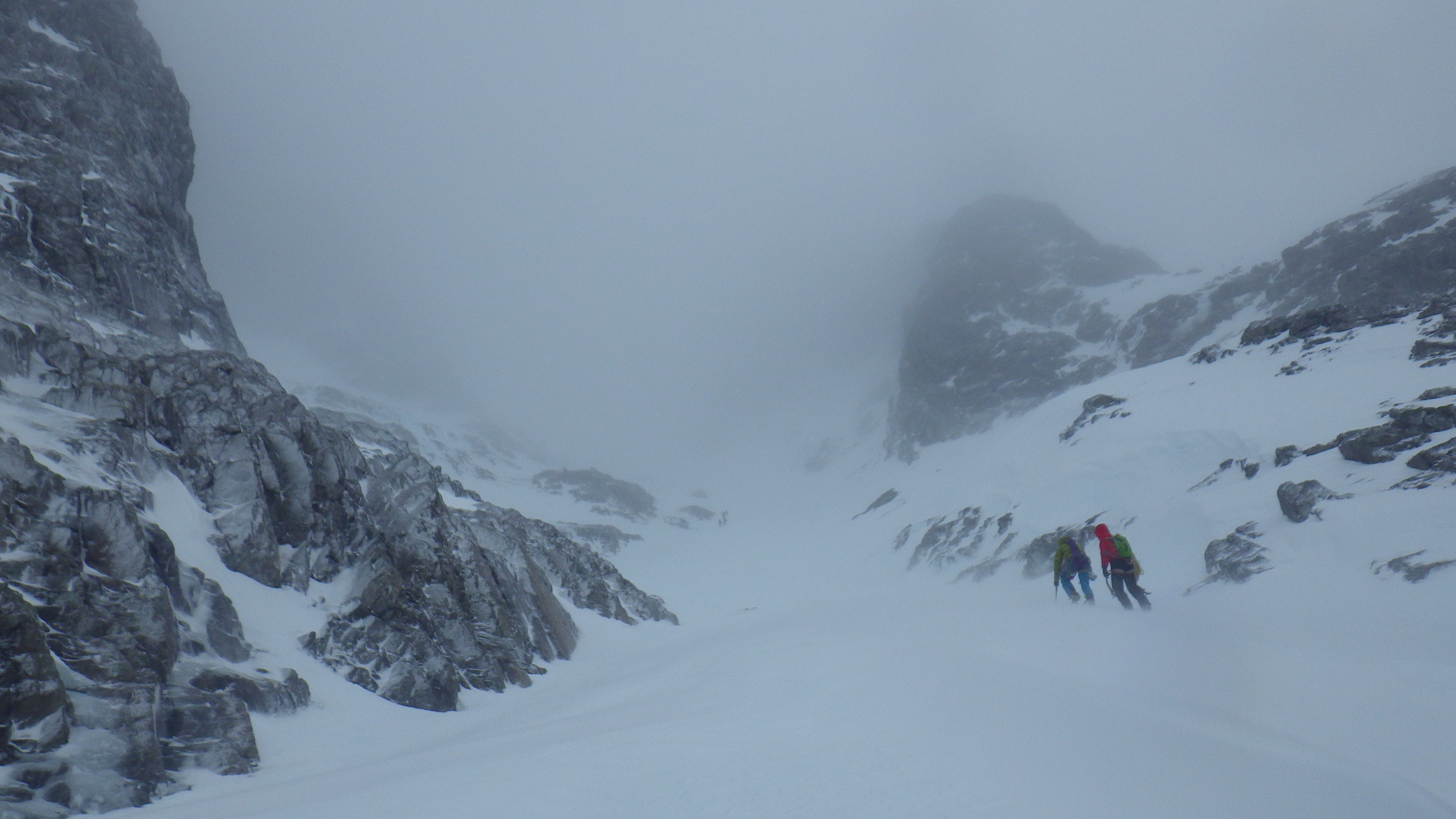
Helen Rennard and myself were getting a bit fed up with waiting for a break in the stormy weather on the mountains, so we went up Ben Nevis on a blustery morning. There had been a very brief overnight thaw which we hoped would firm up the dangerous approach slopes. But as it got light it appeared to have stripped our possible new route objective. I also fell through a snowbridge on the path and went up to my knees in water. So we sat in the CIC hut for a while drying my boots and figuring out where to go.
We opted for the steep walls right of Echo Wall which have few routes and we thought it might be relatively sheltered from the heavy snow shower rattling in from the west. On the way up Observatory Gully we passed a string of goggled-up climbers descending from their route objectives in the blizzard. They optimistically wished us luck as we hid in our hoods and pressed on.
Helen and myself heading up Observatory Gully towards Echo Wall (in cloud). Photo: Blair Fyffe
At the foot of the wall there was relative shelter and and we uncoiled the ropes below an overhanging crack feature soaring up the walls above. Helen had been here previously, but her partner had got very pumped and fallen from the first few metres, with a projected grade of 9 for this section.
I managed to get over this first overhanging section without taking too much time, mainly because I didn’t want to hang about with poor gear in the extremely verglassed crack. On the following section I carried on with care, in the hope I’d get at least one solid runner, but I couldn't seem to get that. Eventually I arrived at an uncomfortable overhung slot below a very steep bulge in the crack above. I spent a very long time here.
I fiddled for ages, going up and down with some fear, trying in vain to get a good runner. Eventually, two very good hooks in the overhang persuaded me to move higher and I got a Spectre in. After a retreat to the slot, this runner provided the security to push a bit higher. A second Spectre went in and I now had enough protection to probe upwards with more commitment. Unfortunately I was by now getting pretty tired and was aware that Helen had been suffering the blizzard for some time without moving. She must have been freezing. On the other hand, I’d put in a fair bit of work and seemed to be only a few moves away from unlocking the pitch. So I committed upwards with a few heart pumping moments and burning forearms to an uncomfortable rest standing on one foot on the lip of the overhang.
I limped onwards to the belay, rather mentally exhausted and went through some savage hot aches before constructing a belay. Helen did a fine job of following the pitch from what must have been a very cold start. Understandably, she asked if I would lead on. The main problem on the final pitch was warming my freezing hands. It seems to me that your brain must shut out the memory of how bad hot aches can be. After descending Tower Ridge, we still had to don the goggles to walk down the Allt a Mhuillin!
We thought it would only be VIII,9 if the crack wasn't verglassed and would accept cams. It was a fine winter adventure - it does sometime pay off nicely if you press on through all the hurdles that Ben Nevis throws at you. But only with your wits about you at all times.
Posted by Dave MacLeod 0 comments
Labels: Ben Nevis, winter climbing
Wednesday, 25 February 2015
Body heat
Sunday boarding from Dave MacLeod on Vimeo.
Having come out of the other side of my massive book project and starting to climb regularly again, I have been thinking a lot about the nature of my need to climb and what I take from the activity. I’m aware that for some readers these comments may sound ridiculous, but they are my feelings and so you can take them or leave them - they simply are what they are.
My deprivation from climbing over the past months and years during this project has been relative. I have still climbed more metres of rock and ice than many people have the chance to and I am grateful for that. I’m also aware that the book project has had still greater disruption for my family. This post is not a moan. I understand that everyone has choices to make in their life which have a big mix of positive and negative consequences and then live with them. Nonetheless, whether it seems self-indulgent or not, the relative lack of climbing over the period had a huge effect on me. A negative effect.
Wanting to make the most of each and every possible opportunity in life can be both an advantage and a big problem. Being drawn in several different directions at once is destructive for success at most things that require work and application. I could write posts about all these directions, but in this I’m just writing about the climbing aspect.
Several years ago a climbing journalist interviewed me soon after I climbed Rhapsody at Dumbarton Rock. I remember him commenting after the interview that he still wasn’t really clear why I liked climbing so much. I think he was not seeing the wood for the trees. I don’t climb to notch up first ascents, to complete hard projects, or to be better than anyone else. Spending my time doing these things is the means, not the end. The end is simply the climbing. The hard projects, training and the pushing yourself simply intensifies the experience. If I’ve pushed myself harder than someone else, it’s simply because I enjoy the climbing that much.
So this need to climb is not something that has to be linked to achievements or grades etc. They merely assist in getting the most out of the climbing. In trying to find an analogy for this basic need to climb, I felt it was similar to the need to have the correct body heat. Imagine you were deprived of the heating or clothing to stay warm. You can still function in your activities of daily life, even enjoy good things. But it is just harder to enjoy them while you shiver. If exposed to this over time, you might even adapt to this state to an extent. The discomfort may fade to a dull hue, no longer at the front of your mind. But it is far from eliminated. At the extremes of deprivation, the discomfort would be strong enough to cancel out satisfaction from meeting any other basic needs or comforts.
Over the past three weeks I have been building back up my basic strength and fitness in my climbing wall. I have found that even when feeling rusty in my movements and weak on the small holds, climbing makes me feel that I can deal with the all the other problems in life. But as I’ve got stronger and fitter, I’ve noticed the effect is stronger. This is more than it being nice to be able to climb things I couldn’t before. The actual climbing feels better. More agility, control and confidence, as well as strength.
The book project has been a reminder that since I’m lucky enough to have opportunities to climb, I should take them wherever possible, not just for the direct enjoyment, but for the effects in all parts of life. It's also reminded me to take the time to train and build up to a good performance.
Posted by Dave MacLeod 0 comments
Labels: Make or Break, perspective, training
Thursday, 19 February 2015
All go
Starting up Feeding Frenzy VI,7 on Ben Nevis last week
February is always all go in Lochaber. First of all, we have been sending out a lot of copies of Make or Break. Thanks to everyone who’s ordered it and I hope it is starting to help you with your climbing and injury rehab decisions already. We’ve had a few recurring questions about it:
‘Is it better [for us] to order it directly from our site, or Amazon?’
Yes it’s better to get it direct from us than the mighty Amazon. We are shipping them all over the world, every day. Plus, you get a signed copy this way!
‘Are we releasing an ebook/kindle version?’
No plans to at the moment, although we might do it sometime.
Thanks for everyone’s great feedback on the book so far. It means a lot.
In between dealing with book related things, I’ve been in my wall training a lot and rebuilding fitness. I love my wall! It’s so great to finally be in there regularly, just pulling on holds and enjoying it. I’ve also been out on the ice which has been in present in large quantities on the Scottish mountains recently.
On the first ascent of Transition VI,7 Ben Udlaidh. Photo: Chris Prescott/Hot Aches Productions
Firstly I visited Ben Udlaidh with Natalie. It’s somewhere I used to go a lot as a youngster and have done several new routes there, most of which are still kind of unknown since the guidebook is so out of date. The day we visited it was just starting to warm up and some pieces of ice were starting to fall off. So we had to grab some of the action quickly before it got a little dangerous. We climbed a lovely unclimbed steep icicle on the lower tier, with some steep mixed pulls at the bottom to gain the ice. Most folk go to Udlaidh for the pure ice lines, but the routes with a little mixed ground are really good fun and rather underrated.
Natalie enjoying an ice cave rest mid way up Transition VI,7 Ben Udlaidh
Approaching the icicle on Feeding Frenzy, VI,7 Ben Nevis
So we returned a couple of days later. I climbed up behind the icicle and at first tried to break a hole through the curtain to access the front face. It seemed pretty solid so I stepped onto it and climbed right around the whole thing and up the right edge of it. It was a fantastic trip and I see it got at least one further ascent from Nick Bullock and Tim Neill some days later. Kev wasn’t able to manage some of the cross through moves on the traverse to the ice with his prosthetic ice tool, so I had an exciting abseil down it to retrieve my gear from the back of the curtain.
Over the last day or two the weather has been poor, so it’s back to training. I’m also at the Fort William Mountain Festival each night over the next few nights. We went to the opening night last night which was brilliant. We premiered our film about the geological and botanical investigations on the north face of the Ben last summer and listened to several great speakers and musicians in a packed hall. There are still some tickets for the remaining nights, so do snap one up if you can make it. We will be in the exhibition hall each night with climbing books and films, and I’m speaking about Make or Break in the Book Festival line up on Saturday afternoon. See you there! Below is the showreel we put together for the festival to give you an idea of the footage in some of this year’s films.
Posted by Dave MacLeod 0 comments
Labels: Ben Nevis, Make or Break
Wednesday, 11 February 2015
Let's get a climbing centre in Fort William!
Three Wise Monkeys Climbing crowd funding film from Three Wise Monkeys Climbing on Vimeo.
Check out the video we made above for Three Wise Monkeys Climbing, who have just launched a crowdfunding campaign to open a climbing centre in Fort William.
The video says it all really, but it’s a simple pitch - all of use who live in the area or visit it for climbing would love a high quality climbing facility in Fort William. They need to raise £40,000 in 28 days. The climbing scene here is pretty small, so don’t leave it to someone else. Go and make your pledge here, and I’ll see you in the wall in the summer.
Posted by Dave MacLeod 0 comments
Friday, 6 February 2015
Make or Break: Don’t let climbing injuries dictate your success
For the past 4 years or so, I have been working on a book about climbing injuries. It spells out in detail how to treat them once you have them, based on the evidence from high quality scientific research and practice. More importantly, it discusses all the things we do in our climbing routine that cause our future injuries and prolong those we have already caused.
I have titled the book ‘Make or Break’. This is because becoming an expert in understanding the causes and treatments of climbing injuries will be make or break for your climbing career. As Wolfgang Gullich said, “getting strong is easy, getting strong without getting injured is hard”. In my first book, 9 out of 10 climbers make the same mistakes, I suggested that many aspects of training for climbing are not rocket science. Keep showing up, pulling on small holds, pushing the limits of your motivation and learning from others and you will get stronger fingers and get better at climbing.
It will be injuries that will get in the way of your progress, and if you let them, they will dictate how far you get in climbing. The research suggests that nearly all climbers get injured at some point. Finger injuries are most likely, followed by elbows and shoulders. Of course there are countless bits of our anatomy that can break if suitably mistreated. When you get one of these injuries, you need to be the expert, because unfortunately you cannot rely on anyone else to make sure you recover. This is not because doctors and therapists fail to do a good job (although they sometimes do). It is because there is no single source of advice on the vast array of things you must do to make sure you recover well and prevent future injuries. The climbing coaches, physiotherapists, otrhopaedic surgeons etc. that you will see will all give you pieces of the jigsaw puzzle, but it is you who must put them together.
Claire MacLeod dispatching our pre-orders the other night.
During the process of writing the book, I have discovered many pieces of hard scientific information and subtle concepts I wish I’d known when I was 16. They would have saved me so much of the pain and psychological torment of injuries that climbers everywhere share at some point in their career. There are many strands of information in the book. It is a handbook on how to take care of yourself as a lifelong climbing athlete. In this blog post, I will briefly outline three messages that will give you a flavour of what you will find in the book:
1. Tendons don’t like rest, or change.
Surprisingly, sports medicine research still has a lot to learn about tendons and how they heal and respond to training. However, there have been several big steps forward in the research over the past decade or two. The only problem is, new knowledge in sports medicine takes years or even decades to filter through to the advice you receive. Consider the following quote:
“In general, it takes approximately 17 years to get 14% of research findings adopted into practice. Moreover, only 30–50% of patients receive recommended care, 20–30% receive care that is not needed or that is potentially harmful and 96% may receive care with the absence of evidence of effectiveness.”
I was shocked too when I read that. I was aware through my own experience that the advice I’d been given to recover from my own climbing injuries was often at odds with research I’d read. But to discover the extent of the lag between research findings and advice given to sportspeople is depressing. We only have one life and we cannot afford to receive outdated advice. Unfortunately, the internet hasn’t made the task of unearthing reliable advice any easier. Scientific journals remain hidden to most behind a paywall, while the same poor quality, outdated and non-specific advice drowns out the few reliable sources.
One of the shifts in understanding from the past decade is that slow-onset tendon injuries such as golfer’s elbow do not respond well to complete rest. In fact, it often makes the condition worse. Moreover, many of the adjunct treatments often offered - stretching, massage, ibuprofen may do little to contribute to healing, and only affect pain. Instead, the most promising treatment has been large volumes of exercise of a specific mode (eccentric) and at a level which causes some pain. Much of this seems counterintuitive at first sight, which is why a detailed understanding of what happens in injured tendons is so important.
Some practitioners in sports medicine are still working to a pre-1990s concept of tendon healing and will advise you to heal your injured tendons by resting them completely. In contrast, modern research has found that the best way to heal injured tendons is to use them, but only in a way that is specific to the nature of the injury. Tendons do not like rest or change. The successful formula is to provide constant stimulus to tendons to maintain their health. But if you want to change that stimulus, such as by training harder, you must do so very carefully, using all the cues from the body that you can listen to.
Section 1 of the book discusses in detail the limitations of the sports medicine industry and how to get the most out of it, and section 4 details the modern understanding of tendon injuries and how to successfully treat them.
2. Know pain, or no gain
Above I hinted at the difference between the pain level and the healing status of an injury - a crucial concept for any sportsperson to understand. Understanding of the nature of pain has been another area of science that has advanced hugely in sports medicine. It is not enough to be able to listen to your body. You need to be able to decode the messages and see the patterns in them. This is both a science and an art.
Climbers need to be able to differentiate between healthy soreness from training and activity, and damage that demands action. They need to be able to take understand how various treatments affect pain from their injuries and what this means for their daily decisions on how much activity to expose them to. They need to understand how many aspects of their environment and psychological state amplify or suppress pain sensations from their daily activities. Pain sensations are an essential measure for climbers to monitor, but without detailed knowledge of how it works, it is very easy to interpret those messages from pain wrongly.
Section 2 of the book is entirely devoted to understanding pain.
3. The luxury of doing sport badly will not last
A young body can withstand a surprising amount of abuse. But the relentlessness of sport and training amplifies the effect of small imbalances or errors, and it doesn’t take long before these accumulate to the point of injury. Balance is the key word here. One area of sports medicine that has come on a fair bit in recent years has been the recognition that athletes need to develop strength in a balanced way, taking care to strengthen muscles on both sides of joints. That is a good development, but it is not enough.
Balancing of the stress imposed by training for climbing needs to come in several other ways too. Matching increases in training intensity with improvements in the quality of rest is one way. Improving technique and the design of the training progression to spread that stress is another.
Sections 1, 3 and 4 deal with these concepts and the specific details that climbers should be aware of which commonly result in climbing injuries.
Repeated forceful internal rotation of the arm (the right arm on this move) is a big part of climbing. So it is no surprise that the internal rotators of the arm at the shoulder become dominant. You may well get years out of a healthy young shoulder without feeling a thing. But the resulting impingement syndrome affects so many climbers. If you'd rather prevent it, it's not hard to do a little work to keep the shoulder joint working well. And if you are already suffering, you may be able to reverse it quite quickly, unless you've really tried to ignore it for too long!
Maintaining awareness of the foot during hand movements is a core skill in climbing injury awareness. Slipping feet are a important cause of many finger and shoulder injuries. Do your feet slip too often? Do you know what to do when they do slip? Correct your climbing technique and you can push your body a lot harder before it starts to complain.
Finally, there is the psychological challenge of injuries which is hugely underestimated by both climbers and their friends and families. In sections 1 and 5 of the book, I present the idea that we should see the injuries we suffer as a crucial message that something must change in our way of approaching climbing. By seeing the injury as an opportunity to go back to basics, to understand what must change and make that change, we can not only improve our climbing, but enjoy the process rather than endure it.
I hope the book will help many climbers prevent their future injuries or overcome existing ones. You'll find the book in our shop here, dispatching worldwide.
Posted by Dave MacLeod 14 comments
Labels: 9 out of 10 climbers, injuries, Make or Break, work
Wednesday, 4 February 2015
Some mixed with Natalie
A quick hot aches break before the crux of Promised Land VI,6 Ben Dorain. All photos thanks to Chris Prescott & Paul Diffley
Over the past week I have been coming out from the shadow of book work and starting to regain some strength on my board. I went out with Kev and tried a hard winter project, but I was not fit enough to do it yet. So there are no shortcuts, I have some work to do to get into shape for my projects. But things are easy when you have had some time off - I feel stronger on my board every successive session. On one hand you want this feeling to last because it’s always nice to feel stronger than before. But It’s also kind of bad because for this to happen I must be really unfit!
Yesterday I had a fun day out with Natalie on Ben Dorain. We climbed a varied VI,6 called The Promised Land. It was one of Nat’s first winter climbs, so I got to lead all the pitches which were varied and interesting, with some nice easier sections on which to get into a better rhythm of moving on turf, ice and rock. I have always been pretty bad at winter climbing compared to summer trad. But yesterday’s climb reminded me how nice it is to move about on tools in well frozen turf and good hooks.
Today I was working for Mountain Equipment and tomorrow myself and Nat are heading down to Beinn Udlaidh for some nice ice.
Natalie Berry following the excellent ice pitch on Promised Land. Paul Diffley took the shot while filming us.
The southern highlands have always been my favourite place for mixed climbing.
Posted by Dave MacLeod 0 comments
Labels: winter climbing
Monday, 19 January 2015
My climbing injuries book is up for pre-order
Readers of this blog will of course know that I have been working on a book on climbing injuries for some years. It has turned out to be a much bigger book than I originally envisaged. It has been a huge project, but in a few weeks I will reach the finish line. The book is currently with the printers and some time in the next few weeks, many boxes of copies will arrive at my house. The final stages were a rather exhausting process, but I’m excited to release it and potentially help healthy climbers stay healthy and injured climbers to get back to the fray.
I’ll write a more detailed post about the content of the book when the stock arrives in early February. If you want to make sure you get a copy as soon as you can, we’ve put it up for pre-order in the shop here, and it’ll be in the post to you as soon as it arrives. I’ve also added the table of contents below so you have an idea of the breadth of the areas covered.
My aim was to write the manual on how to stay healthy as a climbing athlete that I wished I’d had when I was 16. The first priority was to base my writing on the cutting edge of sports medicine research, wherever it was available. The second was to include all the diverse aspects of injury prevention and recovery, and then present them in a way that allows you to see them in the whole context of your efforts to stay injury free. As with the world of training, too many injury texts focus on or overplay the importance of just one aspect of sports medicine.
Having spent around 4 years researching, thinking and writing the book, I do feel that if I’d had access to the information contained in it when I was a teenager, my health and climbing achievements over the past 20 years would have been significantly better. I hope the book can make this difference both for both youngsters who have yet to experience injury, and battle scarred climbers like myself.
Below is the table of contents, so you can get idea of the scope of the book. You’ll find the book in the shop here.
Section 1: Make or break
Why the treatments you have tried aren’t working, and what to do about it.
How to use this book
The real reasons you are injured
Stress and injury
The reason you are still injured
The language problem
The practitioner problem
The sports medicine problem
The missing link
Exceptional use: the luxury of doing your sport badly
Prevention
Your visit to the doctor’s
Summary
Section 2: Know pain, or no gain
Pain and how to read it
Seeing the patterns in your pain
What is healthy soreness?
Understanding your pain
Going beyond reading only pain
Summary
Section 3: Removing the causes of injury for prevention and treatment
Are you only treating symptoms?
What was the real cause?
The big four: technique, posture, activity, rest
Correcting technique
Correcting posture
Activity
How to rest
Warm-up and injury
Lifestyle
Nutrition
Section 4: Rehabilitation of climbing injuries - treating both causes and symptoms
Acute rehabilitation
When to move beyond acute care
Goals of mid-late rehabilitation
Modern understanding of tendon injuries and recovery
Therapeutic activity - basic exercises
Therapeutic activity - climbing
Proprioceptive training
Walking the line of rehab ups and downs
Therapeutic modalities
Surgery
Drug and other emerging treatments
When to stop rehab?
Summary
Section 5: Psychology of injuries: dealing with the anguish of injury
Face it: it really is that bad!
Take heart
Finding motivation
Section 6: Young climbers
What young climbers should know
Too much, too young: a warning
What parents and coaches should do
Section 7: The elbow
Golfer’s and tennis elbow
Brachioradialis/brachialis strain
Other elbow injuries
Section 8: The fingers
Different grips in climbing and consequences for injury
Pulley injuries
When and how to tape the fingers
Painful finger joints
Flexor unit strains
Dupuytren’s contracture
Ganglions
Other finger injuries
Section 9: The wrist
Triangular fibrocartilage injury
Carpal tunnel syndrome
De Quervain’s tenosynovitis
Other wrist injuries
Section 10: The shoulder
Shoulder impingement/rotator cuff tears
Biceps tendon insertion tears
Labral tears
Shoulder dislocation
Frozen shoulder
Thoracic outlet syndrome
Shoulder and neck trigger points
Section 11: Lower body injuries
Foot pain in climbers
Plantar fasciitis
Heel pad bruising
Ingrown toenails
Sesamoid injuries
Hallux valgus
Morton’s neuroma
Ankle injuries in climbers
Cartilage/joint injuries
Ankle impingement syndrome
Achilles tendon pain
Knee injuries in climbers
Meniscus tears
Anterior cruciate ligament tears
Medial collateral ligament tears
Hamstrings tear
Hernia
Section 12: Further reading
Further reading and references
Getting access to good care
The author’s tale of woe and hope
Glossary of key terms
Thanks
References
Posted by Dave MacLeod 9 comments
Labels: climbing injuries, davemacleod.com shop, Make or Break, new stuff, work
Wednesday, 14 January 2015
Mid-winter lockdown
Apart from a brief break with my family over Christmas, I have been on something of a lockdown to get my climbing injuries book ready to send to the printers. No distractions, no messing about, just getting down to serious work. Such is the way with big projects, both on the rock and off. It can be relatively easy to get to the nearly there stage. But exponentially harder to see off all those hurdles that jump up between ‘close’ and ‘done’.
So long as you don’t look at your email inbox, living in the highlands does make it easier to pile drive through work tasks of this nature. I’m desperate to finish them all, stone dead, and then move on and go back to the rock and ice in time for the good conditions arriving.
I spent Hogmanay in PDF print settings hell, and since then have tidied up countless other loose ends that need to be sorted to get it there. Although the little things keep coming, it will be off to the printers imminently, and I will post up more information about it then.
I’ve also just finished three climbing related films, all of a very different nature which will be online soon to show you. As the January gales and rain have raged outside here, I’ve been dashing between the house and the board for training.
Two or three little mid-winter tasks remain on my list, most of which ought to be crushed by some time next week. And then it will be time to climb.
Subscribe to:
Posts (Atom)


.jpg)